Supreme Headquarters of the Allied Expeditionary Forces
Across the River and into the TreesThe Supreme Headquarters of the Allied Expeditionary Forces, referred to as SHAEF, is presented through the Colonel’s recollections as a high-level Allied command whose plans and orders reach the battlefield through layers of authority. Its significance lies in the distance between strategic design and the conditions on the ground: plans to envelop Paris become entangled in delay, while a later order to take a town by assault overrides the possibility of a negotiated surrender.
Identity and Presentation
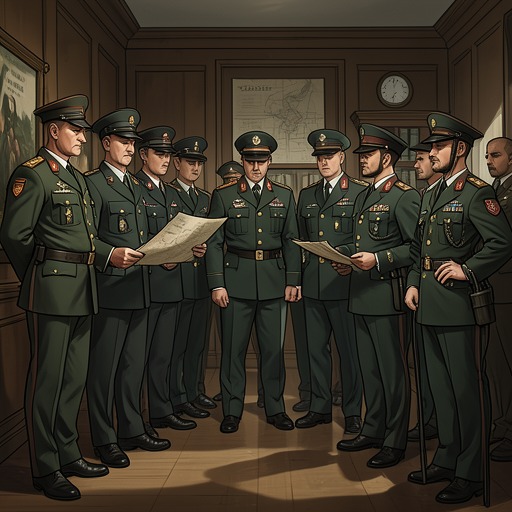
The Colonel expands the acronym for the girl as Supreme Headquarters of the Allied Expeditionary Forces and characterizes it as including military politicians of the rear. He contrasts its personnel, who wore a badge bearing a flame-like design, with his own group, identified by a four-leafed clover that also served as a sign of luck. The account supplies little institutional detail beyond this description; SHAEF is chiefly encountered as a distant presence in the Colonel’s stories of command.
The Plan for Paris
The Colonel recalls that the French had taken Paris four days before the Allies arrived, but says that SHAEF’s grand plan called for the city to be enveloped, so his force could not simply take it. The plan also involved waiting for the possible arrival of Bernard Law Montgomery. In the Colonel’s telling, Montgomery had been unable to close the Falaise Gap and was delayed. The episode makes the headquarters’ planning visible as a source of operational constraint: the city had already changed hands, yet the Allied force’s movements remained subject to a broader scheme and the anticipated arrival of a senior commander. The Colonel recounts the missed meeting with dry irony, but the underlying point is the friction between the plan and events already unfolding.
Orders and Battlefield Consequences
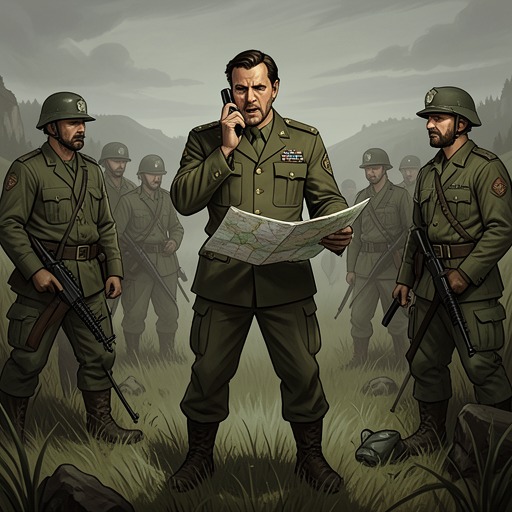
In another account, the Colonel describes trying to move around a town on the way to high ground. He believes the German professionals facing his force might have negotiated if the Allies had sent in a flag. Instead, a telephone order arrives from Corps, passed down from Army or Army Group and possibly SHAEF: the town must be taken by assault. He speculates that the town’s appearance in a newspaper may have made its capture seem important to distant decision-makers. The narrative leaves SHAEF’s precise role in this particular order uncertain, but places it at the far end of a command chain that can turn a local situation into a mandated attack.
Command, Responsibility, and Limits
The Colonel describes the assault as badly arranged: his force would attack in a line of three, with nothing in reserve, and one regiment was committed before the attack began. Removing divisional patches to conceal the attackers’ identity was therefore rendered pointless, since a captured soldier could identify them. The regiment was destroyed. The Colonel does not cast Walter Bedell Smith, whom he identifies as having made promises and explained how the operation would proceed, as a villain; he judges him gravely wrong while resisting a simple assignment of personal blame. In this account, SHAEF represents the reach of senior command and the limits of individual control: orders travel downward, while the consequences are borne by the units sent to carry them out.